How to Create Logos with <path> in SVG: Step-by-Step Guide
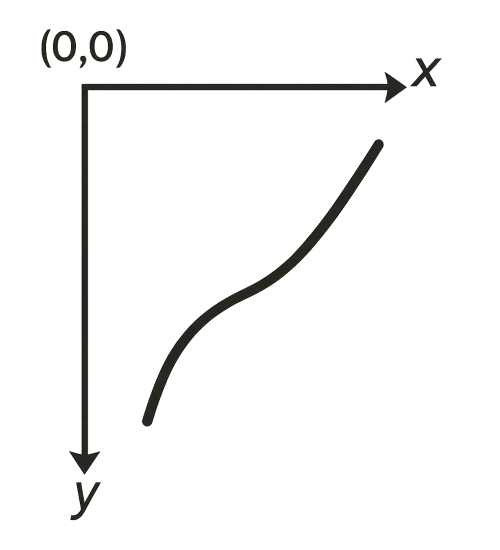
The <path> element in SVG acts like a "pen tool" in vector design software (such as Inkscape) or a polyline in construction tools. It allows you to draw 2D lines and curves starting from the origin (0,0) at the top-left corner of the SVG canvas. By combining points, you can create smooth shapes ranging from straight lines to elegant curves ideal for logos. This guide will show you how to use <path> with practical examples and how to easily design logos at creadorlogos.com. Let's get started!
Step 1: Understand the <path> Structure
The d attribute defines the path trajectory using commands and coordinates. The origin (0,0) is at the top-left corner. Example: a basic triangle.
<svg width="200" height="100" xmlns="http://www.w3.org/2000/svg"> <path d="M10 10 L190 10 L100 90 Z" fill="#ff6f61" stroke="#000000" stroke-width="2"></path></svg>Result:
Breakdown of d="M10 10 L190 10 L100 90 Z":
M10 10: M (Move to) moves the cursor to (10, 10) from (0,0).L190 10: L (Line to) draws a line to (190, 10).L100 90: Draws to (100, 90).Z: Z (Close path) closes back to the start point (10, 10).
Uppercase letters (M, L) represent absolute coordinates relative to (0,0). Lowercase letters (m, l) are relative to the previous point.
Step 2: Drawing Curves with <path>
Use C for cubic Bézier curves, perfect for smooth shapes in logos. Example:
<svg width="200" height="100" xmlns="http://www.w3.org/2000/svg"> <path d="M10 80 C50 10, 150 10, 190 80" fill="none" stroke="#0066cc" stroke-width="4"></path></svg>Result:
Breakdown of d="M10 80 C50 10, 150 10, 190 80":
M10 80: Moves the cursor to (10, 80) without drawing.C50 10, 150 10, 190 80: C (Cubic Bézier) draws a curve with:- (50, 10): First control point (initial direction).
- (150, 10): Second control point (final direction).
- (190, 80): End point.
Learn more about curves at javascript.info/bezier-curve.
Step 3: Combine Lines and Curves
Create a curved arrow combining L and C for a dynamic logo:
<svg width="200" height="120" xmlns="http://www.w3.org/2000/svg"> <path d="M10 60 L50 60 C80 10, 120 110, 150 60 L190 60 L170 40 M150 60 L170 80" fill="none" stroke="#ff6f61" stroke-width="4"></path></svg>Result:
Breakdown of d="M10 60 L50 60 C80 10, 120 110, 150 60 L190 60 L170 40 M150 60 L170 80":
M10 60 L50 60: Line to (50, 60).C80 10, 120 110, 150 60: Curve with control points.L190 60 L170 40: Lines for the top arrowhead.M150 60 L170 80: Line for the bottom arrowhead.
Step 4: Design Your Logo at creadorlogos.com/crear-logos.php
Create logos without writing code manually using creadorlogos.com. Follow these steps:
- Choose Icons: Select from 20 thematic families of vector icons.
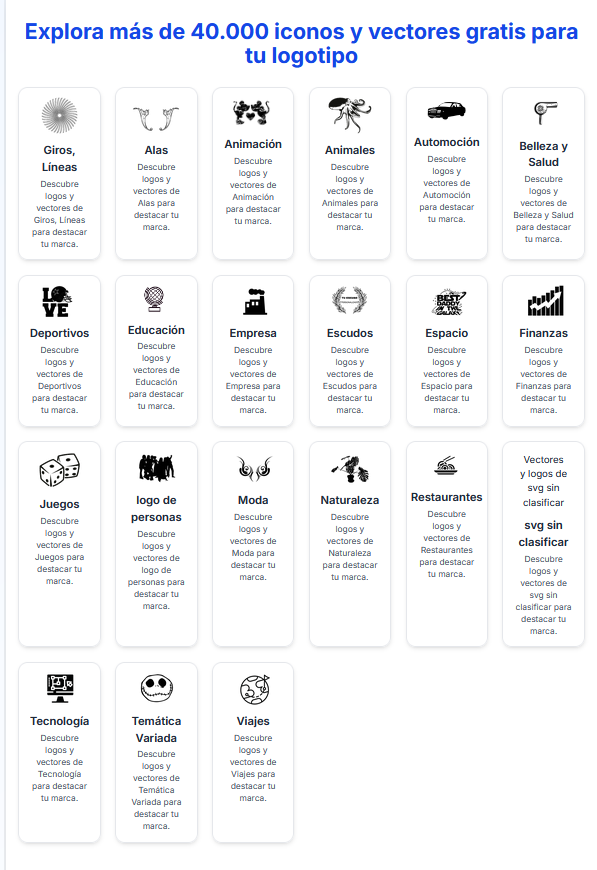
- Add Icons to Canvas: Add as many icons as you want from the families to build your logo.
- Edit <path> elements: Hover over elements; <path> will highlight in green. Press "Del" to remove the selected <path>.
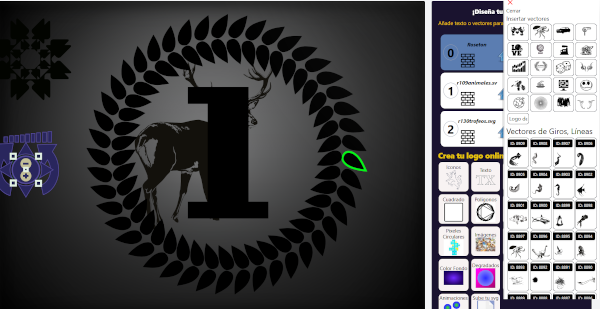
- Duplicate Elements: Select an icon with the left tools, then use Ctrl+C and Ctrl+V to duplicate it as a new object.
- Edit <path> individually: Click "Select vector only" to isolate a <path>.
 Copy (Ctrl+C, Ctrl+V) or transform (scale, move) the <path>.
- Download Your Logo: Export as an SVG file (zipped) or PNG with a transparent background.
Over 10,000 designers trust creadorlogos.com, offering 40,000 SVG vectors for inspiration.
Alternatives: Use Inkscape (free) or Adobe Illustrator to design and export to SVG if you prefer dedicated software.
Curiosity: Generate SVG Code
At creadorlogos.com, click "Generate code" to view the complete SVG with all <path> elements and primitive shapes.
This code is saved to a database and rendered in a new window for editing or reuse.
Final Tips
- Test: Verify your logo across Chrome, Firefox, and Safari.
- Explore: Experiment with more designs at creadorlogos.com.
Share your logo with #DisenaLogos!